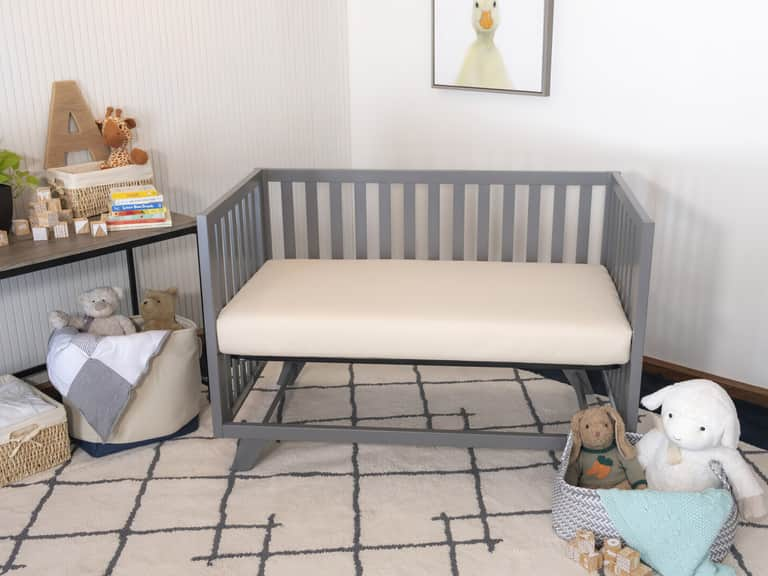
Mattress Care 101
Organic Mini Crib Mattresses: A Guide to Fit, Materials, and Care
A smaller crib can make a nursery feel cleverly arranged, almost shipshape. Its mattress, however, is not a place for guesswork. Mini crib sizes vary, and a mattress that looks close enough may still leave an unsafe gap. Materials and care matter, too, but the first practical question is more prosaic: does it fit the crib exactly as its manufacturer specifies?
The word mini suggests a standard object in a smaller, tidier form. In the nursery, it can instead mean a category with variations. Mini cribs are made for compact rooms, shared spaces, travel, and the first years of a child’s life, but their mattresses are not necessarily interchangeable. A mattress described as “mini crib size” may not fit every mini crib. The label is a starting point; the crib’s instructions and measurements are the authority.
That distinction is easy to overlook when a room is being prepared under deadline. The crib is assembled, the sheets are folded, and a mattress arrives in a box whose dimensions seem plausible. Yet a safe sleep surface depends on the relationship between that particular mattress and that particular crib. Organic materials may be appealing, and an easy-care surface may be convenient, but neither can compensate for an ill-fitting mattress or a setup that conflicts with the crib maker’s guidance.
This guide takes the practical route: identify the crib, measure with care, assess what “organic” does and does not tell you, and follow the maker’s cleaning directions. The aim is not to turn a nursery into a laboratory. It is to make the decisions that protect the mattress—and, more importantly, preserve the intended sleep setup—before routine and laundry take over.
Start with the crib, not the product listing
Before choosing a mini crib mattress, find the crib’s model information and assembly or care manual. The manufacturer should specify the mattress type and dimensions the crib is designed to accommodate. If the manual is missing, the model number may help locate an official copy. A retailer’s general size guide can be useful background, but it should not replace the crib manufacturer’s requirements.
Measure the interior of the assembled crib according to the instructions, checking the length and width at the mattress-support level. Measure the space the mattress must occupy, not the outside of the crib frame. If the support surface has a shape, hardware, or adjustment feature that affects the usable area, follow the manufacturer’s method. A tape measure gives useful information, but it cannot tell you whether a mattress is approved for that crib or whether the support is set up correctly.
Mini crib dimensions can differ from one model to another. Some may be designed around a particular mattress size; others may have a distinct interior measurement. A mattress’s advertised dimensions can also be rounded, and compressible materials may change shape slightly when unpacked. For these reasons, do not assume that two items labeled “mini” are compatible simply because their descriptions sound alike.
When ordering, compare the mattress’s stated dimensions with the crib maker’s specifications, and check any notes about mattress thickness, support height, or approved models. If the information is unclear, contact the crib or mattress manufacturer before use. It is better to resolve a measurement question while the mattress is still in its packaging than after sheets have been washed and the nursery has become a place where every empty box is suddenly needed for something.
What a snug fit means
A properly matched mattress should sit securely in the crib without a gap that could create a hazard. Check the fit in all corners and along every side, following the crib maker’s directions. A mattress that bows, bunches, or shifts in a way the manufacturer does not describe as acceptable warrants a closer look. So does a visible space between mattress and frame. Do not use rolled towels, blankets, foam strips, extra padding, or other improvised fillers to close a gap. Those additions are not substitutes for a compatible mattress.
Fit is not a matter of making the mattress feel plush or tightly wedged by force. A mattress that is too large may buckle or fail to lie flat; one that is too small may leave a gap. The appropriate test is the one specified by the crib manufacturer, not a folk test passed from one nursery to another. If the mattress does not match the crib’s requirements, stop using that combination and ask the manufacturer for guidance.
Thickness matters as well. Follow the crib instructions for mattress height and the correct setting of an adjustable mattress support. As a child grows and can sit, kneel, or stand, the support may need to be lowered as directed. These changes concern the crib’s setup, not just the mattress. A well-fitting mattress cannot make an incorrectly assembled crib safe, and no accessory should be used to alter the sleep surface unless the manufacturer explicitly permits it.
Sheets should be designed for the mattress’s dimensions and remain fitted and secure. Avoid adding loose bedding, pillows, toppers, or positioners to make the mattress feel softer or to compensate for an imperfect fit. For guidance on safe sleep, consult current recommendations from recognized public-health authorities and follow the crib maker’s instructions. When a question involves an infant’s sleep environment, improvisation is a poor substitute for a clear answer.
Understanding “organic” without overreading the label
Organic can be a meaningful materials preference, but it is not a complete description of a mattress. The term may refer to a particular fiber or component, and the details depend on the product. Look for a materials list that identifies the cover, filling, core, and any treatments or barriers. If a certification is claimed, check what it covers: a certification for a textile does not automatically certify every component of a finished mattress.
Common materials in organic crib products include cotton, wool, latex, and, in some designs, other fibers or support materials. Organic cotton may be used in a cover or filling; that does not by itself establish what lies inside the mattress. Wool can appear as a layer or as part of a fire barrier. Latex may be used in a core or layer. Different constructions have different feel, weight, ventilation, moisture behavior, and cleaning limits. The only reliable way to understand a particular mattress is to read its complete specifications and care label.
Certification names can help shoppers compare products, but they are not interchangeable and should not be treated as shorthand for every possible claim about health, safety, or environmental impact. Read the certifier’s scope and the manufacturer’s explanation. A transparent listing should make it possible to tell which materials are certified, which are not, and whether the claim applies to the raw material, fabric, or finished item.
Most important, “organic” does not mean that a mattress is automatically suitable for a particular crib. It does not confirm the fit, thickness, condition, or compatibility. Nor does it make ordinary maintenance unnecessary. An organic mini crib mattress still needs to be used according to its instructions, kept clean in the approved way, and replaced if it is damaged or no longer fits as intended.
It is also useful to separate preference from performance. A family may choose organic materials for reasons involving sourcing, manufacturing standards, feel, or personal priorities. Those are legitimate considerations. But for an infant sleep surface, material preferences belong alongside—not ahead of—correct dimensions, a firm and flat surface as specified by relevant safe-sleep guidance, and the crib manufacturer’s requirements.
Construction and comfort: read the whole description
Product descriptions can make construction sound simple: a cover, a core, perhaps a removable layer. In practice, each component can affect how the mattress should be handled. A removable cover may be washable while the core is not. A waterproof surface may be intended to be wiped rather than soaked. A natural-fiber filling may require special drying or airing. The phrase “easy care” is not specific enough to decide how to clean an accident.
Check whether the mattress has a removable cover, whether the cover is machine washable, and whether the core can be exposed to moisture. Look for clear instructions about washing temperature, detergent, drying method, and whether the mattress should be turned or rotated. If the product listing and sewn-in label disagree, ask the manufacturer which instruction applies to your model. Keep the answer with the manual or product records.
Some crib mattresses have more than one surface or are designed to change use as a child grows. In such cases, follow the manufacturer’s directions about which side to use and when. Do not infer that a reversible mattress should be flipped at a particular age simply because another model uses that arrangement. The correct surface and timing are product-specific.
A cover’s texture or a mattress’s apparent softness is not a dependable measure of suitability. A protective layer can change the feel of a sleep surface and may affect fit; use only accessories the crib or mattress manufacturer permits. The same principle applies to pads and protectors. A product intended for a standard crib may not fit a mini crib, and a general bedding accessory should not be assumed compatible just because it stretches.
A cleaning routine that respects the materials
Cleaning begins with the care label, not with a strong household cleaner. Manufacturers may recommend spot-cleaning, a removable cover’s machine wash, or a particular drying process. Applying bleach, solvents, steam, or scented disinfectants without approval can damage a coating, alter a fabric, leave residue, or push moisture into a core that is not meant to be wet. “More powerful” is not the same as “more hygienic.”
For a small spill, remove the fitted sheet and follow the mattress maker’s instructions promptly. If spot-cleaning is permitted, use only the method and products the manufacturer recommends. Avoid saturating the surface unless the instructions explicitly allow it. Blotting may be appropriate for certain materials, but the maker’s directions take precedence. Let any cleaned area dry fully before remaking the bed, using the specified drying method and allowing enough time for the mattress interior to dry if it has been exposed to moisture.
When a removable cover is machine washable, check the temperature, cycle, detergent guidance, and drying instructions. Do not assume that a cover labeled washable can be tumble-dried on high heat. Heat can shrink fabric or damage a membrane, zipper, binding, or elastic. Likewise, a waterproof layer should not be treated as indestructible. Repeated harsh washing may reduce its performance, even if the textile still looks intact.
Keep a spare fitted sheet if it makes household changes easier, but make sure each sheet fits the mini crib mattress closely and remains secure. A clean sheet is a practical first response to routine mess; it is not permission to stack layers or add loose material. Keep the mattress’s care instructions nearby so that a tired late-night cleanup does not become an experiment with whatever is under the sink.
Ventilation is part of sensible care. After cleaning, allow the mattress and any washable cover to dry as directed. Do not put a damp mattress back into a closed crib or cover it with bedding while moisture remains. Persistent dampness, a musty smell, visible mold, or a wet core deserves attention from the manufacturer; depending on the extent and product design, replacement may be necessary. Do not assume that airing alone resolves contamination inside a mattress.
Protectors, pads, and the temptation to add one more layer
A mattress protector can help guard against everyday moisture and stains, but its usefulness depends on compatibility. For a mini crib, verify the protector’s dimensions and construction against both the mattress and crib instructions. It should fit securely and should not make the mattress bunch, curl, or sit differently in the crib. If the manufacturer does not say that a protector is suitable, do not assume that a generic one is.
Some families prefer a protector because laundering a removable layer can be simpler than cleaning a mattress. Others may be concerned that a waterproof barrier will feel warm or make noise. These are reasonable practical questions, but marketing language cannot settle them. Read the construction details and care directions, and check whether the maker specifies how the accessory affects fit or use. Breathability claims, for example, are not a substitute for checking whether the product is approved for the intended setup.
A quilted pad, topper, or additional cushioning may be designed for another kind of bed and may not be appropriate for a crib. Do not add layers to soften a firm sleep surface or to fill an irregular space. In an infant sleep area, a mattress protector is not a general invitation to build a more elaborate bed. The safest choice is to keep the setup simple and follow the crib and mattress makers’ instructions exactly.
For crib bedding, age-specific safe-sleep guidance is essential. If there is doubt about whether an accessory belongs in the sleep space, leave it out until a qualified source or the product manufacturer clarifies its use. A purchase can be returned; an uncertain sleep setup should not be improvised into service.
When to inspect, and when to stop using a mattress
A quick inspection during sheet changes can help catch trouble early. Look for tears, exposed filling, broken seams, damaged waterproof layers, persistent odors, or signs that the mattress has become misshapen. Check that it remains flat and fits the crib as intended. If the mattress has been stored, moved, or used in a different crib, reassess its condition and compatibility rather than relying on memory.
Do not use a mattress with damage that affects its surface or structure, and do not attempt a repair that the manufacturer has not authorized. Tape, extra fabric, or a homemade cover may change the surface or create loose material. Contact the maker if the condition is uncertain. Follow the manufacturer’s guidance on warranties and replacement, while remembering that a warranty is not a substitute for checking current condition.
Secondhand mattresses require particular attention. They may have been stored damp, exposed to cleaning products, or used with a different crib. Their history may be unknown, and even a mattress that looks clean may not fit a new model. Before use, confirm its dimensions and compatibility, inspect it carefully, and consult the crib and mattress manufacturers’ instructions. If key information is missing or the mattress is damaged, choosing a known, compatible mattress is the more dependable course.
A short checklist before the first night
- Identify the exact mini crib model and read its assembly and mattress instructions.
- Measure the crib’s usable interior as directed, then compare it with the mattress’s stated dimensions.
- Confirm required thickness, mattress-support position, and any model-specific compatibility details.
- Check the fit along every side and corner; do not fill gaps with towels, blankets, foam, or other improvised material.
- Read the full materials list and determine exactly which components, if any, are certified organic.
- Save the care label or instructions and learn which parts can be washed, wiped, or only spot-cleaned.
- Use only sheets and accessories that fit securely and are permitted by the relevant manufacturers.
- Inspect the mattress for damage and let any cleaned surface dry completely as instructed.
The list is not meant to turn bedtime into an inspection ceremony. Once the right mattress is in place and the care routine is understood, most of the work recedes into ordinary household maintenance. The useful habit is to pause before adding an accessory, changing a cleaning method, or assuming that a size label means what it meant for the last crib.
The small details are the whole point
Choosing an organic mini crib mattress is a sequence of ordinary, consequential checks. First comes fit: the crib maker’s dimensions and instructions, followed by a close inspection of the mattress in the assembled crib. Then come materials: what the product is actually made of, which parts carry a certification, and what those facts do—and do not—establish. Finally comes care: a routine built around the manufacturer’s directions rather than broad assumptions about cotton, waterproofing, or household cleaners.
Miniature furniture has a way of making a room seem more forgiving. The mattress should not be treated that way. A snug, manufacturer-approved fit is not a finishing touch to be improvised after the nursery is decorated; it is the foundation of the setup. Organic fibers may align with a family’s preferences, and thoughtful maintenance may help preserve a mattress for its intended life. But the calmest nursery decisions are often the least theatrical: measure, verify, keep the surface simple, and follow the instructions that belong to the exact crib and mattress in front of you.